What Anthropic actually announced
On August 27, 2026, Anthropic opened a research preview of the Model Hardware Standard — built with HHMI Janelia Research Campus — to a first group of scientific labs and advanced manufacturers. Three claims matter:
- Integration collapses. Setting up hardware integration that used to take weeks or months of specialist work drops to hours or minutes. A standardized driver speaks a small set of primitives — read ("get temperature"), write ("set temperature") — that any device with a programmable interface can implement.
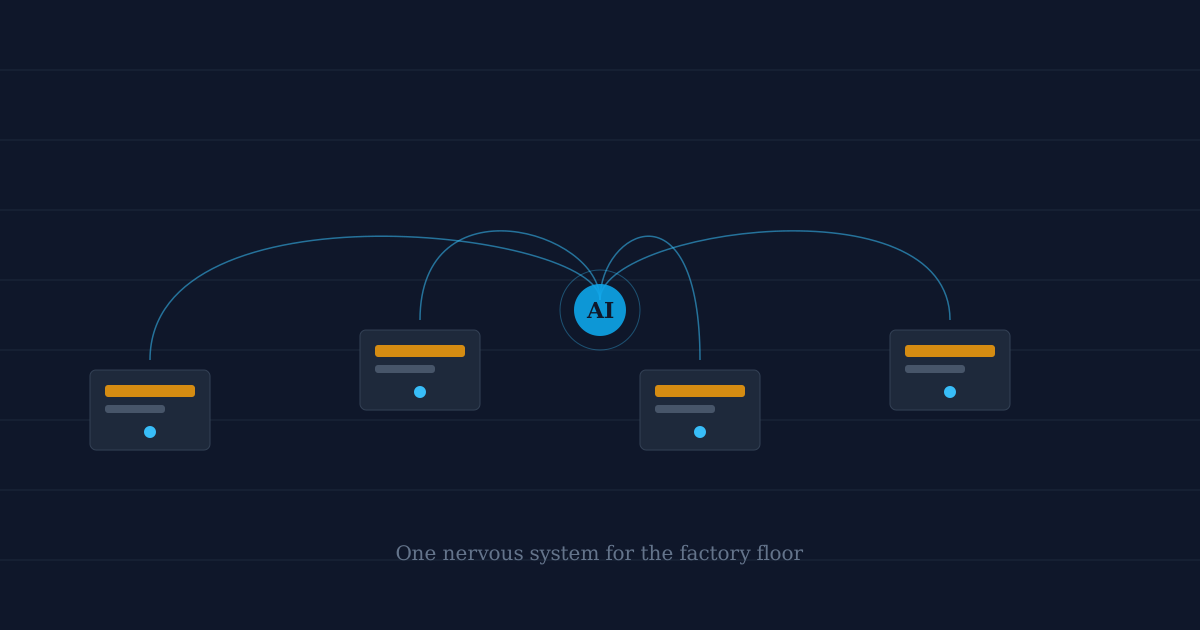
- One agent, many machines. MHS is model-agnostic and works through standard protocols like MCP. A single agent can discover devices on a network, operate several in parallel, sequence steps across instruments, monitor results, and adjust parameters in real time.
- Machines can be self-describing. Drivers carry natural-language tags — the stuff that used to live in paper manuals and a technician's memory ("this arm weighs 40kg, don't move it faster than X"). The agent reads those tags and knows how to use equipment it has never seen before.
Their Genentech proof-of-concept coordinated a liquid handler, a robotic arm, and a plate reader through one agent. A University of Washington lab ran 9,143 automated liquid dispenses across 300 transfer types — and the agent's refined predictions beat the manufacturer's own precision specification on 31 of 45 runs. This is not a demo. It's a standard being battle-tested in production science.
Why this matters more for mid-size factories than for labs
Labs have expensive robots and PhDs to wire them together. You have a 2011 CNC, a 2018 injection molder, Tally, Excel, and a supervisor who is the only person who knows which vendor to call when the second machine jams. The integration problem Anthropic is attacking is your daily reality — except nobody was coming to solve it for a 40-person unit in Baroda.
Until the economics change. A standard means the "bespoke translator for every machine" cost curve bends the same way USB did: one plug, everything works. The labs get it first. The mid-size factory gets it second — but it gets something the labs don't:
Your machines don't need to be intelligent. Your decisions between them do.
Most "smart factory" salespeople will read MHS as "wire up the machines, sell sensors." That's the hardware game — capex-heavy, and exactly where mid-size manufacturers have been burned before. The actual opportunity is downstream of the machines:
- The order book is already digital-ish. Orders arrive by WhatsApp and email, live in Excel, and get re-typed into Tally. Machines produce; the information about production dies in transit.
- The follow-up is human memory. Which RFQ is pending? Which vendor missed a commitment? Which payment is stuck? Your supervisor knows. When he's on leave, you don't.
- The exception handling is tribal. When a job slips, the escalation path is "call the owner." Every time. At 11pm. Because the system has no judgment about which slips actually matter.
MHS-style thinking — standardized drivers, self-describing systems, agents that reason across devices — applied to that layer is what we build. The machines are Tier-1 hardware. The decisions are Tier-3 architecture.
The honest caveats (what most coverage won't say)
- It's a research preview. Partners only, not open source yet. The standard is forming now — meaning the vendors and consultancies who learn its shape first will set the patterns everyone else copies later.
- Your legacy machine needs a programmable interface. MHS works with "any device that has a programmable interface." A 1995 lathe with no controller doesn't qualify. But your order book, your dispatch schedule, your QC checklist, your Tally — those are software, and they're ready today. Start there.
- Safety is being co-developed on purpose. Anthropic is deliberately working with partners on safety evaluations before open-sourcing. Anyone selling you "autonomous factory" today, standard or no standard, is selling ahead of the safety work. That should make you more careful, not less interested.
What a 40-person factory should actually do in the next 90 days
1. Map your chaos before anyone digitizes it
One week. Every order source, every spreadsheet, every WhatsApp group, every person who "just knows" the real status. This map is worth more than any sensor. (This is the first half of our Factory Ops Audit, and it costs you nothing but honesty.)
2. Fix the decision layer, not the machines
Build the system that chases follow-ups, escalates only real exceptions, and hands the owner a one-page daily brief. Zero new hardware. Measurable in weeks: fewer angry-customer calls, faster RFQ turnaround, fewer 11pm surprises.
3. Keep a machine-inventory readiness file
When MHS opens up (and it will — the standard is the point), the factory that already knows every machine's controller, interface, and quirks integrates in hours. The one that starts from a paper manual pile integrates in months. The inventory is free to make now.
4. Watch the standard, don't worship it
Model-agnostic standards like MHS and MCP are good for you precisely because they prevent vendor lock-in. Any consultant selling a proprietary "AI factory platform" is selling you the lock-in MHS is designed to kill.
The bottom line
Anthropic just told the market that AI-operated hardware is becoming standardized infrastructure. For labs, that's acceleration. For a mid-size manufacturer, it's a signal: the technology stack that will run your factory is being standardized while your order book is still in Excel. The factories that win the next five years won't be the ones with the most sensors — they'll be the ones whose decisions moved from a supervisor's memory into a system that reasons, chases, and escalates only what matters.
Get the decision layer right first. The machines will plug in when they're ready — that's what standards are for.
Want the map before the hype?
Our Factory Ops Audit is a 90-minute on-site walkthrough: we map where your orders, follow-ups and decisions actually live, and hand you a 3-page roadmap — whether or not you work with us after.
Book a Strategy Review →